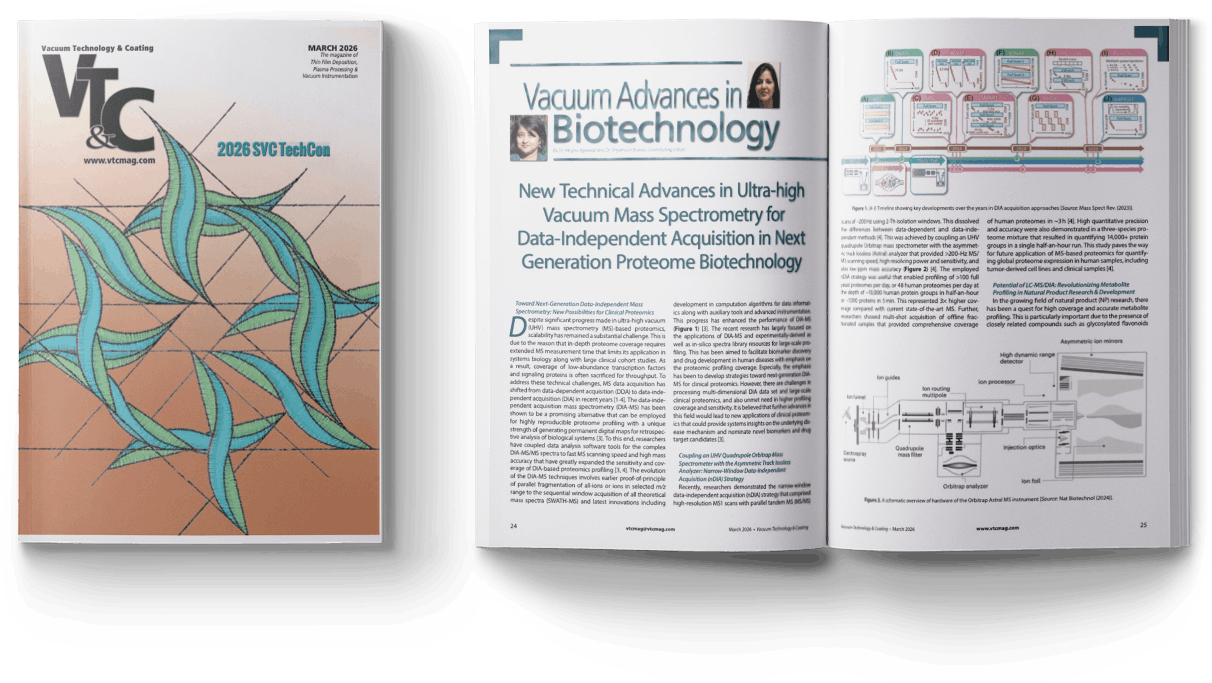
New Technical Advances in Ultra-high Vacuum Mass Spectrometry in Next Generation Proteome Biotechnology
Dr. Megha Agrawal and Dr. Shyamasri Biswas




As manufacturing environments continue to evolve in 2026, so has the role of the fastener. Once viewed as a commodity, fasteners are now increasingly recognized as critical performance components, particularly in clean-critical, vacuum, semiconductor, aerospace, medical, and advanced energy applications. (Click for more)
Construction on our new building has been cruising along—thanks in part to a not-so-wintery winter here in Colorado. This 48,000 sq ft facility will bring our R&D, production and test, quality control, and administrative teams together under one roof. (Click for more)
The advanced vacuum component sector enters 2026 at a pivotal moment. Demand for high-reliability ceramic- to-metal components, hermetic feedthroughs, and ultra-high vacuum (UHV) assemblies continues to rise – especially across the aerospace, defense, semiconductor manufacturing, medical imaging, photonics, and advanced energy sectors. (Click for more)
The formalism we develop reveals that the transport of magnons can induce measurable electric polarization, enabling the control and detection of magnon spin and orbital transport through electrical or optical methods. This finding opens exciting opportunities across the fields of magnonics, spintronics, and orbitronics. (Click for more)




Since 2000 Vacuum Technology & Coating Magazine has been the industry's leading source for the latest articles, news, and product and service information. Below we describe some of the terms that you will find in a typical issue of VT&C.
Vacuum Coating (Vacuum Deposition and Thin Film Deposition) is the process of depositing a film or other material atom by atom or molecule by molecule onto a surface in a low pressure environment or vacuum.
Physical Vapor Deposition or PVD refers to vacuum deposition methods which involve the material (which is being deposited) going from a condensed phase to a vapor phase and then to a thin film condensed phase. Sputtering and evaporation are common PVD processes.
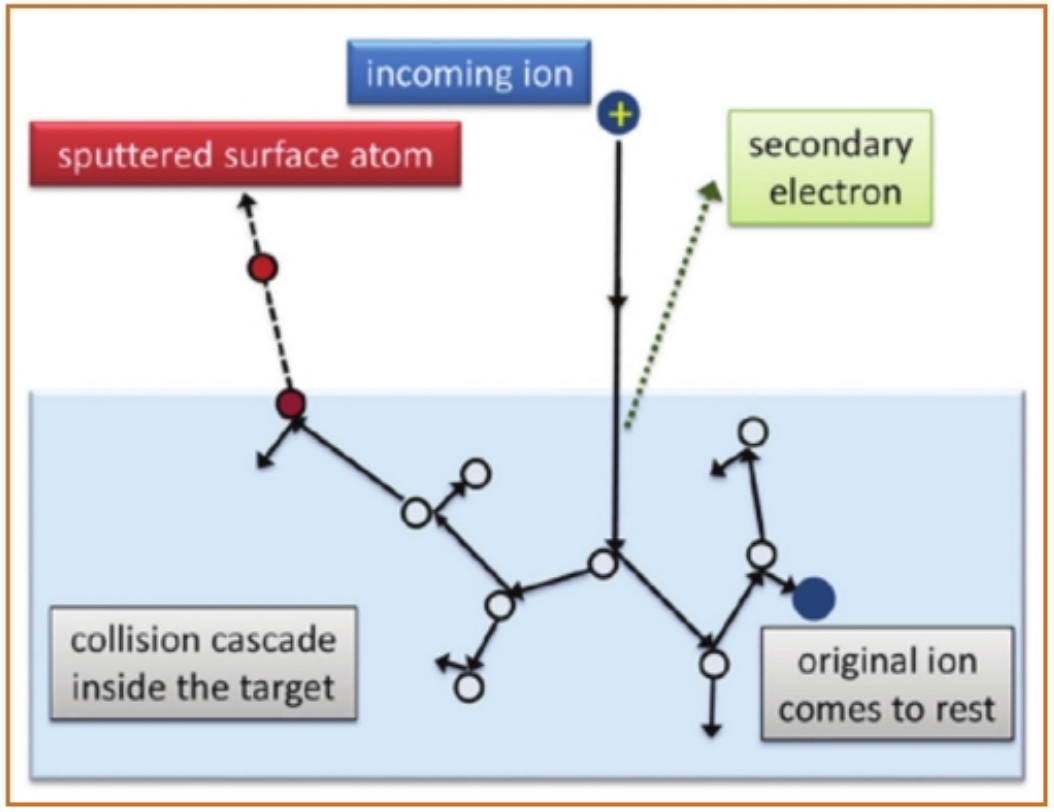
Sputtering refers to a type of process used to deposit thin films and employs a plasma to bombard and eject atoms from a target source.
Evaporation refers to the heated source material being evaporated in a vacuum. Vacuum allows vapor particles to travel directly to the target object, where they condense back to a solid state. (called a Deposition Source) refers to a type of process used to deposit thin films and employs a plasma to bombard and eject atoms from the target source (called a Deposition Source).
Vacuum Hardware refers to the types of hardware and components that are used in the vacuum process. There are many types of hardware used in this process, some examples are flanges, fittings, seals, valves, and chambers.
Thin Film Metrology involves determining the optimal thickness, composition and/or condition of a coating through various techniques and mathematical calculations.
Gas Analytical Systems are used in the analysis of residual gases within a low pressure environment or vacuum.
Vacuum Pumps are devices that remove gas atoms and molecules for the purpose of leaving behind a partial vacuum. Some examples of types of vacuum pumps are rotary vane pumps, diaphragm pumps, and scroll pumps.
Every issue of VT&C includes a product showcase focused on a specific topic relevant to Vacuum Processing, please see our 2026 editorial calendar which lists the topic for each issue.