More Advanced Features of the Fourier-AI Innovations Software for Denoising Spectra
Dr. Matthew Linford and Team





Researchers at the Department of Energy’s Lawrence Berkeley National Laboratory (Berkeley Lab) have discovered that an ultra-thin version of a common material displays an electrical property that could make it a game-changer in the push toward energy-efficient microelectronic devices. (Click for More)
Summer is usually quiet in the U.K. and most of Europe, with a majority of people taking annual vacation for a few weeks. Against this backdrop, it was refreshing to see over 700 semiconductor industry executives gather at a one-day conference in London for the first TechWorks Semiconductors to Systems Summit (S2S26). (Click for More)
Pfeiffer Vacuum+Fab Solutions Launches the New SplitFlow 350 Turbopump Pfeiffer Vacuum+Fab Solutions – a member of the global Busch Group – has expanded its portfolio of turbomolecular vacuum pumps with the SplitFlow 350, a compact model designed for high gas throughput and demanding industrial processes. (Click for more)
New engineered materials demand new approaches as insights into ultra-thin films, surfaces, and interfaces are often obscured by the limitations of even traditional surface analysis techniques. StrataPHI 3.0 introduces an updated characterization platform designed for non-destructive, depth-resolved analysis of multi-layer films composed of ultra-thin layers. (Click for more)




Since 2000 Vacuum Technology & Coating Magazine has been the industry's leading source for the latest articles, news, and product and service information. Below we describe some of the terms that you will find in a typical issue of VT&C.
Vacuum Coating (Vacuum Deposition and Thin Film Deposition) is the process of depositing a film or other material atom by atom or molecule by molecule onto a surface in a low pressure environment or vacuum.
Physical Vapor Deposition or PVD refers to vacuum deposition methods which involve the material (which is being deposited) going from a condensed phase to a vapor phase and then to a thin film condensed phase. Sputtering and evaporation are common PVD processes.
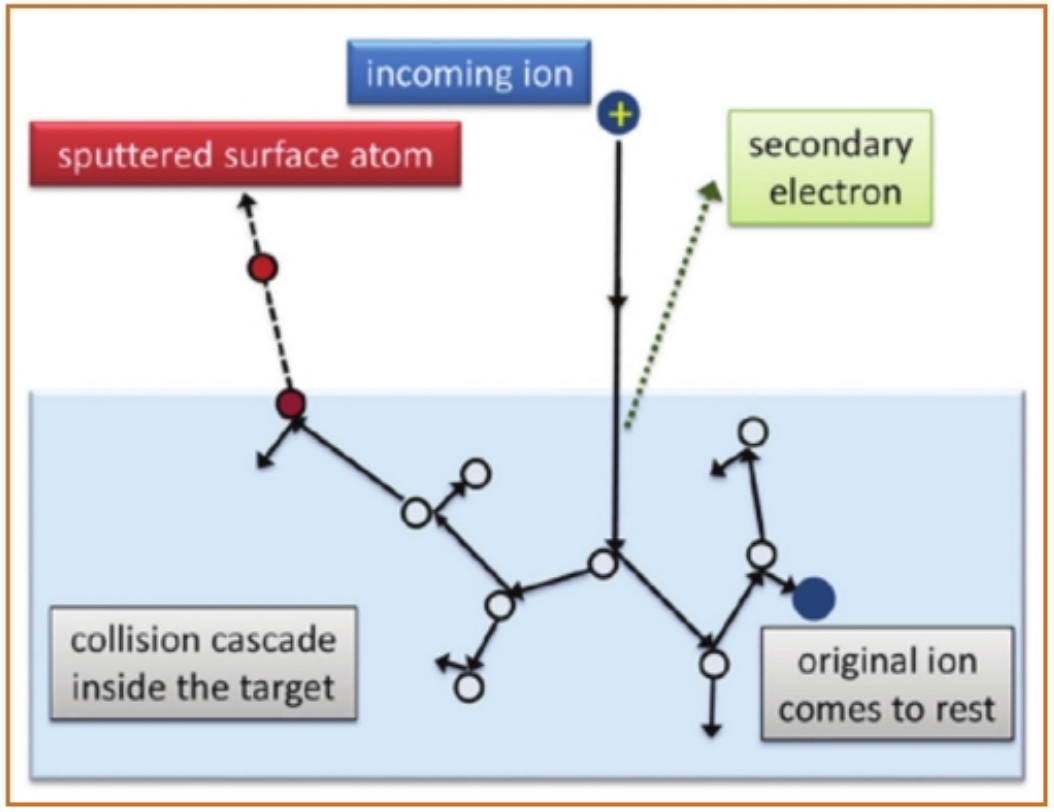
Sputtering refers to a type of process used to deposit thin films and employs a plasma to bombard and eject atoms from a target source.
Evaporation refers to the heated source material being evaporated in a vacuum. Vacuum allows vapor particles to travel directly to the target object, where they condense back to a solid state. (called a Deposition Source) refers to a type of process used to deposit thin films and employs a plasma to bombard and eject atoms from the target source (called a Deposition Source).
Vacuum Hardware refers to the types of hardware and components that are used in the vacuum process. There are many types of hardware used in this process, some examples are flanges, fittings, seals, valves, and chambers.
Thin Film Metrology involves determining the optimal thickness, composition and/or condition of a coating through various techniques and mathematical calculations.
Gas Analytical Systems are used in the analysis of residual gases within a low pressure environment or vacuum.
Vacuum Pumps are devices that remove gas atoms and molecules for the purpose of leaving behind a partial vacuum. Some examples of types of vacuum pumps are rotary vane pumps, diaphragm pumps, and scroll pumps.
Every issue of VT&C includes a product showcase focused on a specific topic relevant to Vacuum Processing, please see our 2026 editorial calendar which lists the topic for each issue.